
Main menu:

Site search

Categories

September 2010
M T W T F S S
« Aug    
 12345
6789101112
13141516171819
20212223242526
27282930  

Tags

Blogroll

5 Tips for becoming a Great Team Member

Team Members
An effective volunteer team is made up of great team members. As you go, strive to be a great team member by displaying the following attributes.


Selflessness – Your primary role on the trip is to be a servant. Forget about your self and serve your team, your leaders, your hosts, the nationals and everyone else with whom you come into contact.

Commitment – Your responsibility as a part of the team requires a decisive commitment. Plan to attend all team meetings, adhere to all team standards, honor all team deadlines, and contribute your effort and energy to the goals of your trip.

Flexibility – In the volunteer world, plans and schedules are often modified and adjusted. In fact, the only constant is change. Prepare yourself to adapt quickly and graciously deal with any changes to the plans.

Optimism – Circumstances on a volunteer trip will not always be ideal, but your attitude and outlook can and should remain positive. The success of your team depends on it.

Cultural Sensitivity – On your trip, keep in mind that you and your team are the visitors. You should act respectfully in regard to the cultures and customs of your place of volunteering.

Share and Enjoy:
  • Twitter
  • Facebook
  • Digg
  • del.icio.us
  • RSS

5 Real-Life Reasons You’ll Be Glad You Bought a Volunteer Card

Trip Delay

Problem 1 – Tropical Storm Lucy has decided to rain on your parade. Your team planned on leaving today, but your plans are delayed along with the plane.
Solution – With the Volunteer Card you are covered for weather-related travel delays of 12 hours or more.

Problem 2 – You are finally fulfilling your life long dream of Volunteering in South Africa and then the Airline Mechanics go on strike.
Solution – With the Volunteer Card you can be covered up to $750 total for Travel Delay if you are delayed for 12 hours or more.

Accident and Sickness Medical Expense

Problem 3 – You take six weeks off of work to bike across America to raise awareness and funds for human trafficking. You break your leg on the road.
Solution – With the Volunteer Card you can be covered up to $100,000 in accident medical expenses.

Lost or Stolen Baggage/Personal Effects

Problem 4 – You put your luggage down for 5 minutes to get a newspaper and come back to find it stolen.
Solution – If your luggage is lost, damaged, or stolen, the Volunteer Card can cover you for up to $2500 in replacement items.

Baggage Delay

Problem 5 – After hours of traveling you’ve finally made it to your hotel to find that your luggage is missing. The airlines know where your bag is but they will not be able to get it to you until the following day.
Solution – If your luggage is delayed for 24 hours or more, with the Volunteer Card you will be reimbursed for the purchase of essential items.

Travel Assist

Unfortunately, everything doesn’t always go according to plan while you’re on a Volunteer Trip. To assist you during these difficult times, the Volunteer Card provides 24-hour customer care and assistance.

Some of the many included services:
Medical Evacuation Assistance
Emergency Medical Payments
Prescription Assistance
Legal Assistance
Travel Document Assistance
Emergency Cash Transfer
Emergency Interpretation Services
It is nice to know that when you are traveling, The Volunteer Card will support you in unexpected emergencies.

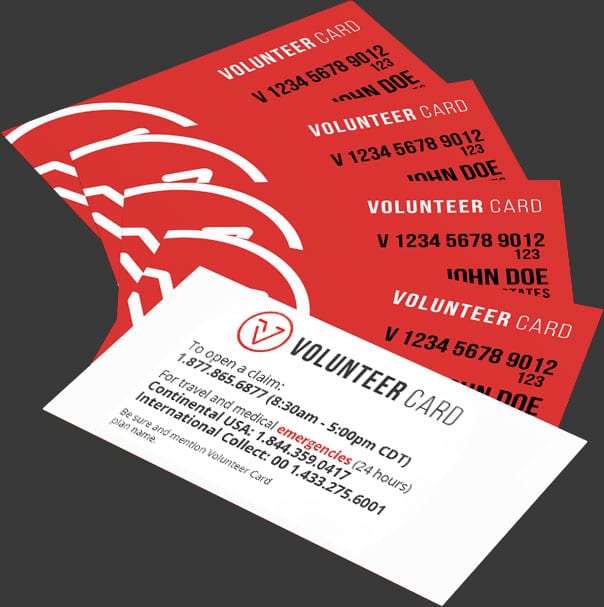
Volunteer card

Click here to purchase your card today before you travel. Don’t be stuck at the airport kicking yourself because you didn’t.

Share and Enjoy:
  • Twitter
  • Facebook
  • Digg
  • del.icio.us
  • RSS

Alexandra’s Volunteer Story- Her Journey to Africa and Back

In June 2009 I left the States to fulfill a life long dream of doing volunteer work in Africa. I spent my summer doing a volunteer internship in Kayafungo, Kenya, with Think Impact (formerly called Student Movement for Real Change). The summer was spent experiencing every emotion I have ever known, as well as a multitude of new ones; seeing and doing things I could have only dreamed about; itching enough bug bites to cover my body nine times over; and recognizing a new-found humbleness for the blessings in my life – including everything from my family to material things like a toilet and clean, accessible water. It was not until I got home from Kenya that I realized my life had been impacted and touched so deeply, and that I would never be the same again.

While I was in the small rural community of Kayafungo, I saw life in a raw and poverty-stricken form. However, through every crack of hardship and despair, there was hope, love and friendship. I made friends with a woman named Grace, through pure chance, and after only a brief conversation I knew she would be in my heart forever. Through talking with Grace, I learned that she shares a unique bond with her husband, one that is uncommon in her community – a relationship based on trust, love and, most importantly, respect. Grace has the unique opportunity to have a voice and an opinion, and she is aware of her special situation. Together, she and I gathered many women in the community to hold a focus group to discuss health issues facing the women of Kayafungo.

After this meeting, the group realized the power in numbers, and how their voices were united in saying the same thing, “Increase health, help our female youth and raise our voices to be heard.” Inspired, the women – led by Grace – formed the Kayafungo Mungano (United in Swahili) Women’s Group (KMWG). We worked together to create a soap business to begin a flow of revenue to help fund future projects, beginning with building a Women’s Action Center to house their new soap endeavor. The Women’s Action Center is to be a beehive of activity, from serving as a permanent home for the soap business to offering training on female health issues, such as breast and cervical cancer, nutrition, and sanitation, and providing a place of friendship.

Leaving at the end of the summer was surreal. The last two weeks of my stay in Kayafungo were when I met Grace, helped form the women’s group and made lifelong bonds. While I was looking forward to a nice hot shower, I did not want to leave. When I got on the plane home from Kenya, I did not cry tears of sadness for leaving; I smiled to myself, knowing that I ignited a spark in the women of the KMWG and that our journey together was not over – it had only just begun.

I am now a proposed Fellow with Think Impact, and I am raising funds for the Women’s Action Center. The Center will be a safe environment for women to discuss ideas and topics freely and to empower one another to be the change they wish to see within their own lives. Each woman I met has her own unique attributes, and when together, united as a group, these women can change their stars. I know that this idea of changing one’s destiny may sound trite, but as a woman growing up in the United States surrounded by strong-willed, confident, female role models who have made a name for themselves and shown me how I can do anything I set my mind to, I have no doubt that together the women of Kayafungo and I can create sustainable positive change within their community. I am thankful for my opportunity abroad, and hope that others know that even a single person can ignite the light of change within someone else, and that the light can turn into a fire within the community. Our generation needs to reach out to others; we can be the change we want to see in the world.

Share and Enjoy:
  • Twitter
  • Facebook
  • Digg
  • del.icio.us
  • RSS

Aubrie’s Volunteer Story

This past summer I spent 10 weeks in Costa Rica volunteering with a sea turtle restoration project.  I worked mainly with the Olive Ridley sea turtle, which is the smallest species of sea turtle, although other species were encountered.  During those 10 weeks I camped out on a remote beach 5 miles away from the nearest town.  The majority of the work took place at night since sea turtles are nocturnal nesters.  Our work consisted of walking 5-10 miles nightly looking for any sign of sea turtle presence on the beach.  Most of the time we would notice their tracks first since sea turtle tracks are hard to mistake for anything else.  We would then follow the tracks up to either find that the mama sea turtle was still laying her eggs, in which case we would tag her flippers, measure her carapace and collect her eggs while she was laying them; or in the case we had missed her we would try to find her nest in order to relocate the eggs to a protected hatchery.  The eggs would then incubate for an average of 56 days, once hatched we would collect the hatchlings in a bucket and take them back to where they were originally laid.  

In Costa Rica and many of the latin american countries, poaching of sea turtle eggs is a huge problem.  In addition to protecting the nests we would educate the locals on the importance of what we were doing since all sea turtles are critically endangered.  I had an amazing experience as a volunteer and would strongly encourage any one interested to do something similar.  I purchased the volunteer insurance card in case of an accident since I was living in such a remote area.  Luckily I had no accidents and just had an  experience of a life time.

Share and Enjoy:
  • Twitter
  • Facebook
  • Digg
  • del.icio.us
  • RSS

Sarah’s Volunteer Story

I had the wonderful opportunity to travel to Pommern, Tanzania for three and a half weeks.  I traveled through the Global Volunteers Organization. While in this grossly impoverished village, I had the opportunity to do a variety of service projects.  The most memorable of these projects was working in the medical clinical.  As a physical therapy student, myself and my classmate Amber had the opportunity to treat a little girl named Farraja over the course of a week and a half. Farraja was an 18 month old girl and was referred to us because her mother was concerned that her daughter was not yet rolling, sitting on her own, or walking. We completed an evaluation on this little girl and determined that she was developmentally delayed from a congenital condition called cerebral palsy. In testing her other systems we also determined that she was blind and mostly deaf.

On her first visit we looked at how well she was moving.  Her arm muscles were very tight, her leg muscles were also tight, and her hands were constantly fisted. Because our Swahili was poor- only conversational at best, we needed assistance to translate.  Patricia, the medical lab assistant served as our interpreter.  When asked about her movement, Ames, the child’s mother said that she does not move a lot and her hands never really open.  For a week and a half, Amber and I worked with Farraja to improve her ability to sit, increase her abdominal muscle strength, and stretch the tight muscles in her arms and legs. We worked with her for about an hour a day, and gave Ames exercises and activities to do at home.  

After only a few visits, Amber and I decided that Farraja needed night splints (braces) to keep her feet in a good position at night and prevent the muscles in her lower legs from forming contractures. Due to grossly limited resources available in the village, the splints were not very aesthetically appealing, but they worked! The splints were made from tongue depressors, wood scraps, duct tape, fabric scraps, and padding that we cut out of construction masks.  We spent 4 days constructing the splints and over an hour making them fit appropriately.  Farraja wore the night splints the night before we left Pommern, and Ames reported that she thought they would do a lot of good, and was very grateful for all of our hard work.

Even though we were only able to work with Farraja for a short time, it was amazing to see the small changes in function that were occurring! Ames noticed the changes too! At our last visit with Farraja, she demonstrated the ability to actively open her hands by herself and was grasping objects that we put in her hands.  Ames stated that she was more active and noticed that she had started to move her arms and legs more.  She still needed assistance to sit, but the amount of assistance was less than when we began working with her.  Overall, I think we had a great impact on this family and they definitely impacted us. This experience taught me to be resourceful and reminded me of how valuable and rewarding volunteer work and developing personal relationships with people of various cultures can be! Hopefully, Farraja will continue to improve in her skills and the staff at the medical facility will update us periodically on her progress.  This was truly a positive, life-changing experience!

Share and Enjoy:
  • Twitter
  • Facebook
  • Digg
  • del.icio.us
  • RSS

Tom and Julie’s Volunteer Story

My husband and I lead Medical Teams to Bolivia, we went with a group called Project Helping Hands (project-helping-hands.org). PHH’s goal is to provide medical care to Third World Countries who wouldn’t otherwise have access to medical care.  In 2009 , we led a total of three teams.  The first trip was in March, we visited Villages in the Mountainous Regions of Northern Bolivia.   In June, we led a team on a River Adventure where we treated people living in Villages along the Amazon River Basin.  In August,  we treated people living at 13,000 feet above sea level.   We have had numerous adventures, and several near death experiences.

On this trip we treated 1,600 patients, took care of a patient who was almost killed by a rock slide, taught good health in many of the Villages.  Overall, we had a wonderful trip.  Everyone of the volunteers stated that they are looking forward to joining us again in the future.  Randy an NY Policeman stated that this trip was the highlight of his life!

Share and Enjoy:
  • Twitter
  • Facebook
  • Digg
  • del.icio.us
  • RSS

Hello world!

Welcome to the Volunteer Card Blog.   We’re excited to share with you stories of Volunteerism around the world.

Share and Enjoy:
  • Twitter
  • Facebook
  • Digg
  • del.icio.us
  • RSS